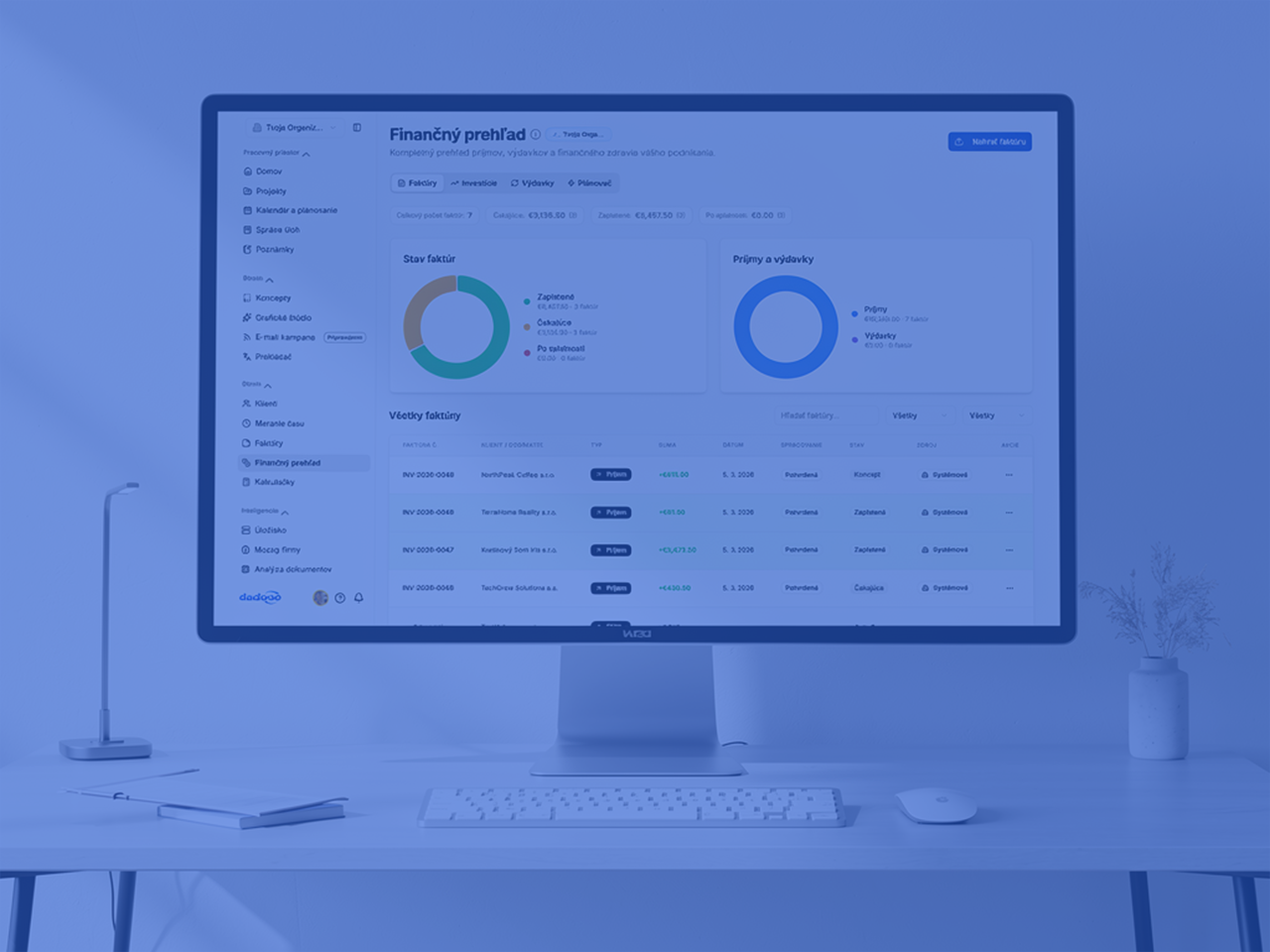
The world is full of great apps. Right now you might be using Notion for notes, Monday for project management, Trello for quick ideas, and iDoklad or Fakturoid for invoices. From a distance it all looks modern and professional — until you add up the monthly licence fees and realise how much precious time you waste clicking between windows and copying data from one tool to another.
Global tools are built for the American market or multinational corporations. They don't understand your Slovak or Czech invoice, they don't handle our specific VAT rates, and their built-in AI has absolutely no context about your local business.
That's why we decided to put DADOOO head-to-head against the world's giants and local players alike. We analysed more than a dozen systems — not to compete with them for sport, but to show you, without any marketing fluff, a hard truth: one connected ecosystem in 2026 means far more to a business than ten isolated, even world-class, tools.
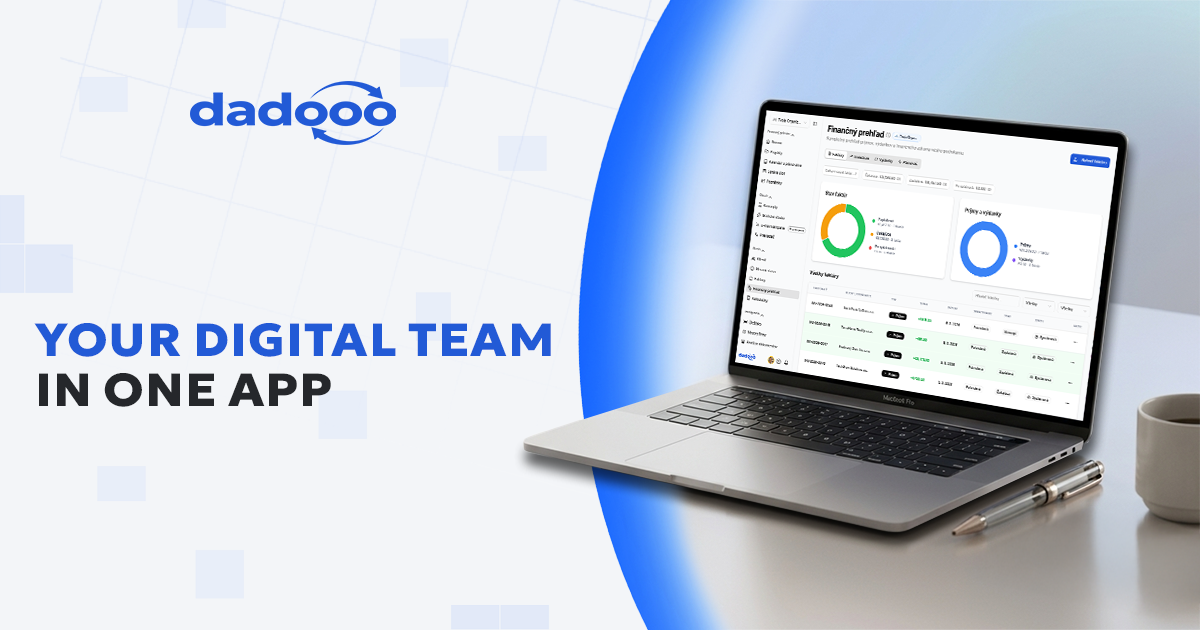
1. Battle of the Giants (and the Rest of the Market): Where Do We Really Differ?
For a complete picture, let's look at what the market actually offers and where the limits of each platform lie from the perspective of a typical Slovak or Czech company.
Notion: The king of notes — and the prettiest time trap around. It's a fantastic blank canvas. You can build relational databases and link wiki pages. The problem? The data inside is isolated and doesn't talk to anything else. For real-world business management, cash flow, and automated invoicing it's far too complicated. You'll end up with one person in the company working full-time as the "Notion maintenance guy."
Monday.com & ClickUp: Project giants with no creative side. Great for complex projects, Gantt charts, and corporate processes. But the moment you need to handle marketing, AI content creation, or issue an invoice compliant with local legislation, you're lost. Monday also penalises you on pricing (licences must be bought for a minimum of three or five users). ClickUp, meanwhile, is so complex that you can't roll it out in a smaller company without an external consultant.
Trello: Fine for visual boards and digital sticky notes. Great for a shopping list or collecting inspiration, but you can't run a complex business on it. That's simply where it ends.
Asana, Jira, Wrike, Smartsheet (the corporate standard): Asana looks polished but locks basic features (like Timeline) behind expensive plans. Jira is designed exclusively for IT and developers. Wrike's UI feels frozen in time, and Smartsheet is just cloud-based Excel for finance departments.
Freelo & Caflou (local heroes): If you reject global tools, these are the Czech stalwarts. Freelo suits simple tasks and has a great whole-team pricing model. Caflou excels at cash-flow monitoring. But both lack what matters most for modern business in 2026 — deep integration of AI and content creation into the actual workflows.
DADOOO: One of a kind. We're not building yet another task-ticking clone. DADOOO is the only system on the market that natively brings four pillars together under one roof: Workspace (projects & tasks), Content (AI content generation & marketing), Core (finances, invoicing, CRM) and Knowledge (your company Brain).
2. Why DADOOO's "All-in-One" Wins (The Maths Is Unforgiving)
Business managers today suffer from "SaaS fatigue." You pay for a pile of software and at the end of the month the bookkeeper processes a stack of licence invoices in dollars and euros. Here is the hard maths of what DADOOO replaces in your current stack — for a single subscription:
- Projects & tasks: Replaces expensive licences for Monday, Asana or ClickUp. (Saving approx. €15/month per user)
- Marketing & AI: Replaces subscriptions to ChatGPT Plus, Jasper, Copy.ai or Canva. AI lives directly inside the system. (Saving approx. €40/month)
- Invoices & finances: Replaces dedicated apps such as iDoklad or Fakturoid. (Saving approx. €15/month)
- CRM & time-tracking: Replaces Pipedrive for lead tracking and Toggl for time measurement. (Saving approx. €30/month)
TOTAL SAVING: More than €100 per month — plus ten fewer software invoices to process. Over a year that's thousands of euros staying in the business.
3. The Local Advantage: SK/CZ Legislation (What Notion Can Never Do)
You can build the most beautiful client database in Notion. But when you need to issue an invoice, you hit a hard truth: you have to create it manually, or pay an expert to connect Notion to Fakturoid via Make (Integromat). The moment the API changes, the whole thing collapses.
In DADOOO, localisation is the foundation. The tool generates legally compliant documents for the Slovak and Czech markets in literally two clicks. We have built-in calculators for our taxes and social contributions. The system knows exactly what differentiates a VAT-registered business from a non-registered one under local rules. No complex integrations — everything is native, right inside.
4. Connected Context: When Your Tools Finally Talk to Each Other
The biggest pain with today's tools is that they're isolated from the rest of your business. In Notion, Trello or Asana the data is static. A task is just a task.
In DADOOO, tools share a single context. Your marketing module (Content) knows exactly which projects are active in Workspace. Your company Brain (Knowledge) knows who you invoiced last month and for what, right inside the Core module.
What does that mean in practice? When you ask the AI in DADOOO to write a client email or craft a social-media post, it doesn't generate some generic, robotic text. It writes based on your real CRM history, understands your tone of voice, and adapts to the context of the specific project you're working on. That's the difference between a toy and a real business tool.
5. The Clear Verdict: Who Wins?
We won't be evasive — the right choice depends on your goals:
- If you're an IT development company running agile sprints, stay in Jira.
- If you want your company to be a beautifully designed digital library and don't mind wiring everything together yourself, stay in Notion.
- If you need to visualise complex corporate processes for hundreds of people and have the budget for it, go with Monday.com.
- But if you want to run a real business, grow, create content, and stop throwing money at 10 different subscriptions, the answer is DADOOO. It's the ideal choice for freelancers, creative and digital agencies, and smaller local businesses that finally want everything in order.
Conclusion
Running a business in 2026 isn't about who has the most app icons on their desktop. It's about who has more time for real creation, for clients, and for growth.
A broken process costs you money and patience. We built DADOOO so that from the first idea, through delegating work, to the final legally compliant invoice, you need nothing else. One system, one payment, full context. Try it — and you won't go back to the old patchwork of apps.